The Seam Ripper Is Your Friend
No sewist wants to talk about it—but every sewist does it………
In the age of high-speed sewing machines and digital pattern cutting, hand sewing might feel like a lost art—slow, old-fashioned, maybe even unnecessary. Many modern sewists avoid it entirely, lacking confidence in their stitches or unsure when and how to use them. But here’s the truth: hand sewing is the quiet hero of garment construction. Whether you’re fixing a hem, closing a lining, or adding the finishing touches to a couture piece, knowing a few simple stitches can save your project—and your sanity. Even if your machine is your main tool, these three basic hand stitches will give you control, finesse, and flexibility when it matters most. And once you learn them, you’ll never look at your needle the same way again.
It’s easy to assume that everything can be done faster and better by machine. But there are times when only hand sewing will do. Need to sew in a hard-to-reach spot? Attach a button? Make an invisible seam? Tidy up a last-minute repair? That’s hand sewing’s domain.
Yet many beginners skip it out of fear:
✔ “What if my stitches aren’t strong?”
✔ “What if they look messy?”
✔ “What if I can’t keep them even?”
The good news? You don’t have to be perfect. Hand sewing is forgiving, practical, and with a little guidance, surprisingly easy to master. Let’s look at three foundational stitches that can handle most of your sewing emergencies—and elevate your finished projects.
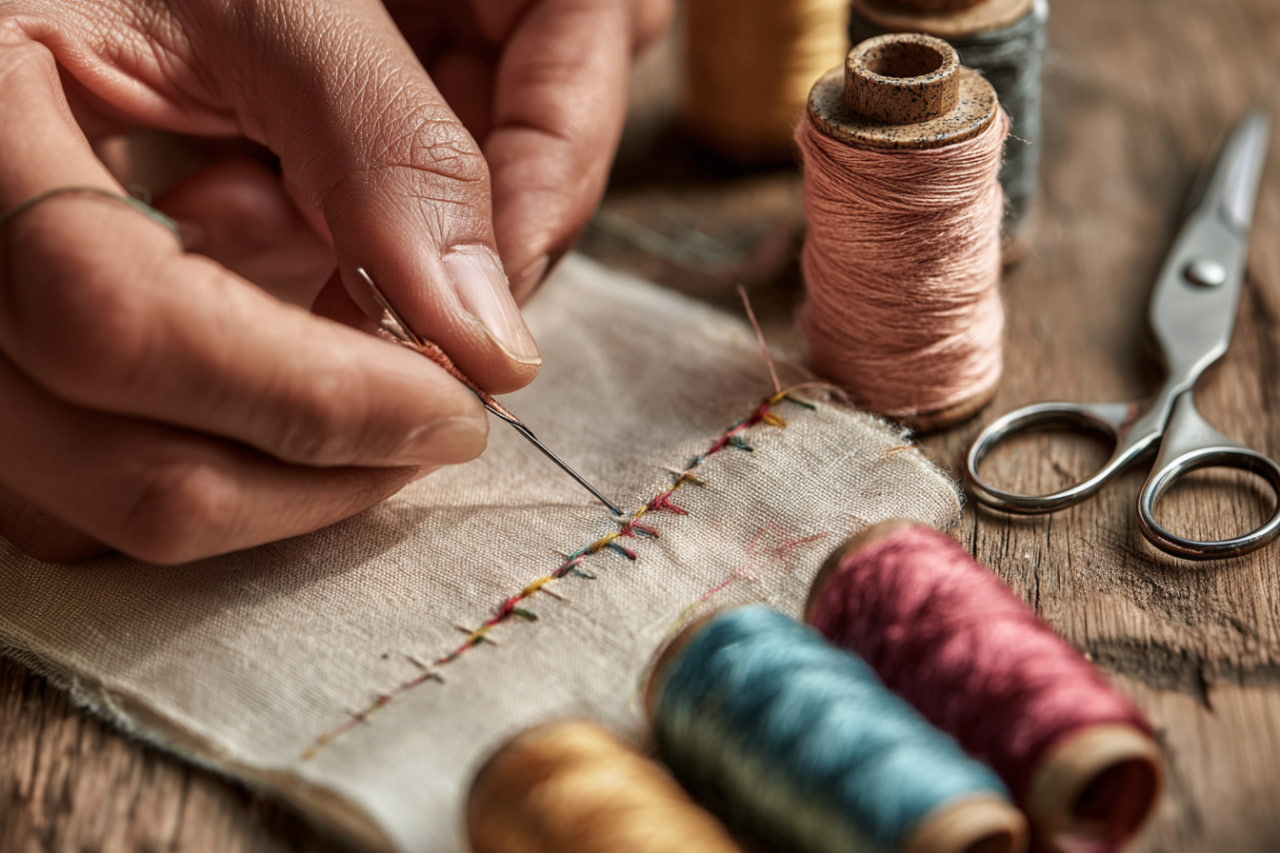
The running stitch is the simplest hand stitch you can learn—and one of the most versatile. It’s a straight, even stitch used for seams, gathering, quilting, or even basting.
✔ Thread a needle with a length of thread (about 18–20 inches to avoid tangles) and knot the end.
✔ Insert the needle up through the fabric, then down again a short distance ahead.
✔ Continue weaving in and out in a straight line with small, even stitches.
For stronger seams, keep stitches close together. For temporary seams (like basting), make longer stitches you can easily remove.
✔ Quickly basting two pieces together before machine sewing.
✔ Sewing seams in lightweight fabrics.
✔ Creating gathers by gently pulling the thread after stitching.
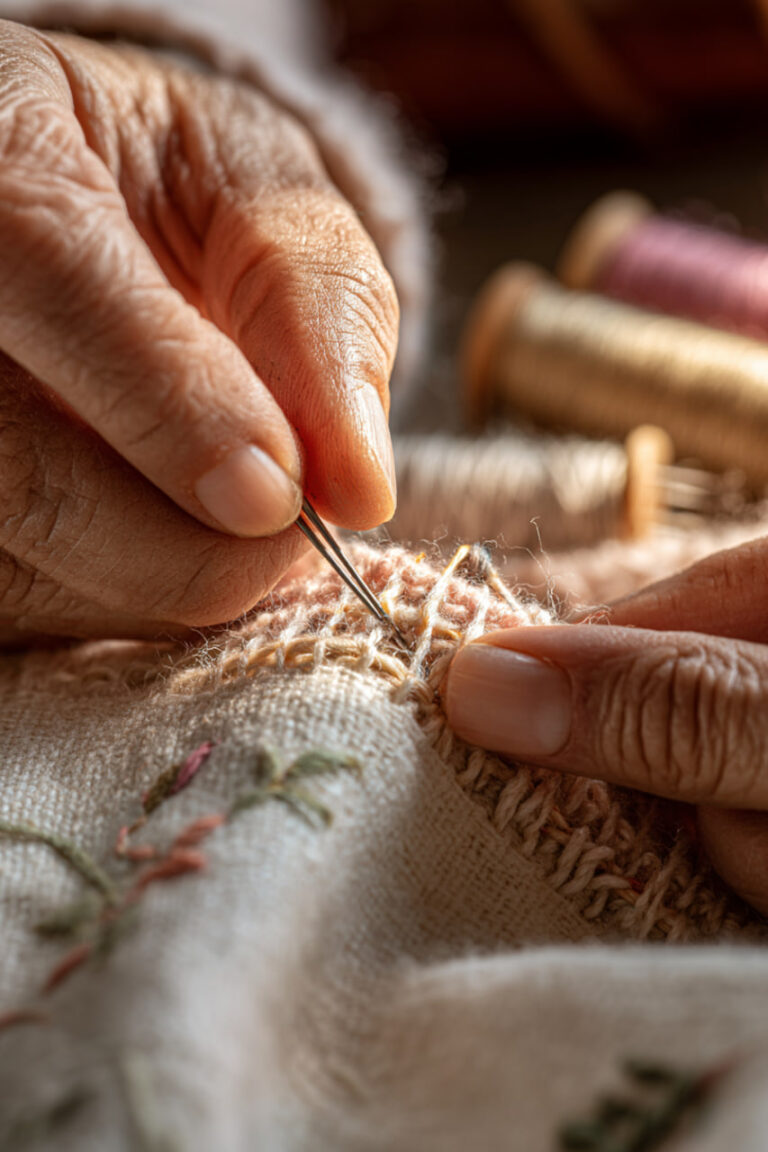
Need to sew a lining closed or hem something invisibly? The whipstitch is your answer. It secures two folded edges together with small diagonal stitches, often used to close openings left for turning garments right side out.
✔ Fold your fabric edges inward (wrong sides together).
✔ Starting from the inside, bring the needle up through the fold on one side.
✔ Cross over and insert the needle through the fold on the other side.
✔ Repeat, spacing stitches about 1/8 inch apart for a neat, tight closure.
✔ Closing openings in lined garments or cushions.
✔ Hand-hemming garments where stitches must remain hidden.
✔ Attaching facings or waistbands on the inside of garments.
Also known as the slip stitch, the ladder stitch is used when you want your sewing to disappear completely. It’s perfect for closing linings, hems, or hand-finishing delicate garments.
✔ Fold the fabric edges under and align them.
✔ Start inside the fold to hide the knot.
✔ Stitch straight across to the opposite fold, taking a small bite of fabric.
✔ Go back and forth in a zigzag pattern, forming tiny “rungs” of a ladder.
✔ Pull the thread gently, and the stitch will close seamlessly.
✔ Closing openings in lined garments or cushions.
✔ Hand-hemming garments where stitches must remain hidden.
✔ Attaching facings or waistbands on the inside of garments.
✔ Use a sharp needle appropriate for your fabric—embroidery needles for thick materials, fine needles for silks or synthetics.
✔ Double-thread for extra strength on high-stress areas like buttons or closures.
✔ Wax your thread with beeswax or run it through thread conditioner to prevent tangling and fraying.
✔ Keep tension consistent—pull thread gently to avoid puckering.
Hand sewing isn’t just a fallback—it’s a finishing tool, a repair strategy, and a creative outlet all rolled into one. These three stitches are more than enough to give you confidence in your work, fix problems on the fly, and give your projects that extra polish that machines can’t always deliver. So next time you’re tempted to skip the hand sewing step, don’t. Embrace the rhythm of the needle, the satisfaction of precision, and the quiet power of a craft that’s stood the test of time—one stitch at a time

No sewist wants to talk about it—but every sewist does it………

You’ve carefully cut the fabric. You’ve followed every step of the pattern instructions. ……